The Shopify SEO playbook for merchants
A practical SEO operating system for Shopify stores covering collection architecture, product-page optimization, internal links, faceted navigation, structured data, content hubs, and measurement.

Editorial note
This guide is written for operators managing a live Shopify catalog. It focuses on decisions that affect crawlability, discoverability, merchandising, and revenue, not generic SEO theory.
What a Shopify SEO program actually needs to do
A strong Shopify SEO program has to do two jobs at once. First, it has to help Google find, understand, and prioritize your money pages, especially collections and products. Second, it has to publish supporting content that captures research demand and channels that attention back into the commercial parts of the store.
In practice, that means SEO is not mainly a metadata exercise. It is an operating system for category design, product detail quality, internal-link intent, faceted navigation control, structured data, and measurement. If those layers are weak, writing more articles rarely fixes the underlying problem.
Shopify does give merchants a useful base. It automatically generates canonical tags,
sitemap.xml, and robots.txt, and lets you edit titles, meta
descriptions, URLs, and image alt text. That removes some technical friction, but it does not
solve weak merchandising architecture or thin content on pages that are supposed to rank.
The working thesis
Most Shopify stores are not underperforming because they forgot to write meta descriptions. They are underperforming because their store structure does not clearly express search intent, product importance, and buying context.
Start with crawlable commerce architecture
Google’s ecommerce documentation is unusually direct here. Search does not infer importance mainly from pretty URLs. It infers importance from how pages are connected and how easily it can reach them.
“Google uses links as a signal when determining the relevancy of pages”
For a Shopify merchant, that means your navigation, collections, featured modules, related products, editorial hubs, and footer architecture all shape how search engines understand your catalog. A collection that exists in the admin but sits buried behind filters, search boxes, or JavaScript-heavy interactions is much weaker than one that is linked plainly and repeatedly from the parts of the site that matter.
Google also states that it is strongly recommended to link to all products you want indexed. That is especially important for large catalogs where some products are only discoverable through on-site search, tag pages, or filter interactions.
“It’s strongly recommended to link to all products that you wish indexed.”
The practical standard is simple:
- Your best categories should be reachable from primary navigation.
- Subcategories and collections should expose crawlable links to products.
- Important products should not depend on a search box to be discovered.
- Anchor text should describe the destination, not say “click here” or “view more”.
Important pages should not sit too deep in the site. Shopify’s own guidance suggests keeping pages within roughly three clicks from the homepage where possible.
This is why SEO for Shopify is really store design. You are not only deciding what users can browse. You are deciding what search engines can understand.
Build collections around intent, not merch accidents
Collections are often the biggest untapped SEO asset in a Shopify store. They sit at the point where search demand meets merchandising. A well-built collection can rank for broad, high-intent terms while still helping users narrow into products. A weak collection becomes just a grid with a title and no real reason to exist.
Start by separating collections by search intent, not just internal admin convenience. In other words, build collections around the way a buyer thinks:
- type of product
- use case
- brand or franchise
- format or size
- beginner versus premium need state
- seasonal or event-driven demand
Then make sure each important collection earns its existence. That usually means:
- a clear H1 and title tag mapped to a real keyword theme
- intro copy that explains the category in plain language
- merchandising logic that surfaces the right items first
- supporting FAQs or buying guidance when the query is educational
- links to adjacent collections, buying guides, or comparison pages
Many Shopify stores create too many overlapping collections that target almost the same query. That splits internal authority and creates unnecessary duplication. In most cases, a smaller set of stronger collection pages beats a sprawling taxonomy of thin category pages.
Good collection pages do two jobs
They satisfy search intent and help the shopper make progress. If a collection does neither, it is probably not an SEO asset. It is just inventory exposed on a URL.
Make product pages rankable and buyable
Product SEO on Shopify is usually misunderstood. Merchants often treat the product page as a place for a short sales paragraph, a few images, and a price box. That may be enough for paid or repeat traffic, but it is often too weak for organic search, especially on products that compete against marketplaces, brand sites, and other retailers.
Strong product pages combine commercial clarity with information depth. They help Google understand what the product is, and they help the shopper understand why this is the right item to buy now.
At minimum, important product pages should cover:
- what the product is, in natural language
- who it is for
- important specs and dimensions
- compatibility, material, fit, or edition details where relevant
- shipping, returns, preorder, or delivery expectations
- genuine imagery that supports the purchase decision
- FAQs pulled from real customer objections
This is also where titles and meta descriptions matter. Shopify recommends unique titles and unique meta descriptions written in natural, readable language, not keyword lists. Good title tags improve relevance. Good snippets improve click-through rate.
“Use natural, readable phrases, rather than lists of keywords.”
For many stores, product-page improvement is a higher-return SEO task than publishing another top-of-funnel article. If your most important products are thin, your content program is trying to pour traffic into weak landing pages.
Handle variants, filters, and duplicate paths carefully
Shopify SEO gets messy when merchants ignore duplication. Variant URLs, filtered collections, tag combinations, sorted paths, and empty-result states can multiply pages far faster than the team realizes. Google’s recent ecommerce guidance is very clear that faceted navigation can create serious crawl inefficiency if it is not controlled.
“can create an SEO nightmare if not implemented carefully.”
The problem is not that filters exist. Filters are good for users. The problem is that filter combinations can generate a huge number of low-value URLs. Google warns that this can lead to overcrawling and slower discovery of important pages.
For Shopify stores, the operating rule is:
- Let important category pages be indexable.
- Be skeptical of indexable filter combinations unless they serve a unique search intent.
- Do not let empty filtered states accumulate as if they were valuable landing pages.
- Keep canonical behavior consistent.
- Do not create multiple routes to the same product or collection without a reason.
Variant handling deserves special attention. Google’s ecommerce URL guidance says to make sure each variant can be identified by a separate URL when variant distinctions matter. That is useful when buyers search for a specific size, color, material, or configuration.
“make sure that each variant can be identified by a separate URL.”
But separate URLs only help when the page experience also supports the distinction. If every variant URL collapses into almost identical copy, with weak differentiation and no search value, you are just manufacturing duplication. The goal is consistency, not maximal URL production.
A sane filter policy
Index category pages and intentionally chosen landing pages. Treat most other parameterized filter states as user-navigation aids, not assets that deserve search visibility.
Build supporting content that strengthens commercial pages
Blog content is useful, but only when it supports the store’s commercial architecture. A lot of Shopify SEO content fails because it captures curiosity traffic with no clear path into revenue pages. The right model is to publish content that answers the questions buyers ask before, during, and after product evaluation.
The most useful editorial page types for Shopify stores tend to be:
- buying guides
- comparisons
- care, usage, or maintenance guides
- size, fit, compatibility, or configuration explainers
- benchmarks or data pages
- niche or vertical playbooks
For example, a store selling collectible products might publish:
- a guide to storing and protecting sealed items
- a comparison between bundle-building approaches
- a niche guide for trading card stores or vinyl stores
- a shipping policy explainer for held orders or preorders
The job of those pages is not just traffic. Their job is to make your collection and product pages more understandable, more linked, and more trusted. If a store uses a workflow like
Addora-style Buy Now, Ship Later
, the supporting content should explain who the workflow is for, how held orders work, when shipping is charged, and how customers release a combined shipment.
Related: Shopify conversion rate benchmarks, Shopify AEO guide, Shopify B2B guide for merchants, Shopify B2B on one store, best Shopify bundle apps, Shopify guide for trading card stores.
The internal linking model
Internal linking is one of the clearest controllable levers in Shopify SEO. Google states that it uses links both to discover pages and as a relevance signal. That means the structure of your internal links changes what Google understands to be important, related, and worth crawling more deeply.
The most useful model for merchants is a readable hub-and-spoke system:
Pillar guides link to relevant collections, comparisons, tools, and niche pages.
Collections link to product pages and, where appropriate, supporting buying guides or FAQs.
Products link to adjacent guides only when the link reduces buying friction.
Comparisons and niche pages link back to the pillar and forward into the most relevant commercial destinations.
Benchmark and glossary pages collect links because they are reference assets, then route that authority into money pages with contextual links.
The key phrase is contextual. If a guide links to every vaguely related page, the structure becomes noisy. The best internal links help the reader make the next useful decision.
Keep the graph readable
Internal links are strongest when they feel editorially inevitable. Put the next-best page in front of the reader at the moment they need it, with descriptive anchor text that matches the destination.
Structured data and search-surface coverage
Shopify merchants should think beyond ten blue links. Google can use ecommerce structured data to show products in merchant listing experiences, product snippets, Google Images, and other shopping-related surfaces. If your product pages are important revenue pages, they should help search engines understand price, availability, and other relevant commerce details.
“price, availability, and shipping and return information”
For merchants, this matters because better machine-readable product information can improve how your store appears across search surfaces, not just whether it ranks. Structured data does not replace good content, but it does help Google classify and present pages more accurately.
In practical terms, your SEO playbook should include:
- valid product and offer markup on product pages
- consistent handling of variant entities where variants matter
- clear return and shipping policy information when supported
- organizational markup where appropriate
- routine validation in Rich Results testing and Search Console enhancement reports
If you are also using Google Merchant Center, treat product data consistency as part of the SEO system. Google’s ecommerce guidance makes clear that structured data and Merchant Center can work together across different shopping experiences.
What to measure
Most merchants track SEO too loosely. Total organic sessions are useful, but they hide the real story. A healthy Shopify SEO program should be measured by page type, query intent, and business contribution.
Google’s Search Console documentation is especially helpful here. It shows which queries drive impressions and clicks, which pages have strong or weak CTR, and how performance changes over time. Google also recommends using Search Console together with Analytics so you can compare pre-click search data with post-click behavior and conversions.
The core dashboard should include:
- non-brand clicks and impressions by page type
- landing-page groups for collections, products, guides, comparisons, and benchmarks
- CTR outliers, especially high-impression pages with weak clicks
- query clusters, not just individual keywords
- assisted conversions and revenue from organic landing pages
- indexation and enhancement issues for product-rich-result eligibility
- link growth to benchmark, glossary, and reference assets
In most stores, one of the highest-value reviews is to look for pages that are already getting impressions but underperform on CTR or conversion. Those are often faster wins than trying to rank an entirely new page from zero.
Measure by intent bucket
Separate informational, comparative, and commercial pages. When all organic traffic is blended into one number, merchants often overinvest in traffic pages and underinvest in revenue pages.
A practical 90-day operating cadence
The cleanest way to run Shopify SEO is in cycles. Most stores do better with a repeated operating cadence than with a giant one-time audit that becomes stale.
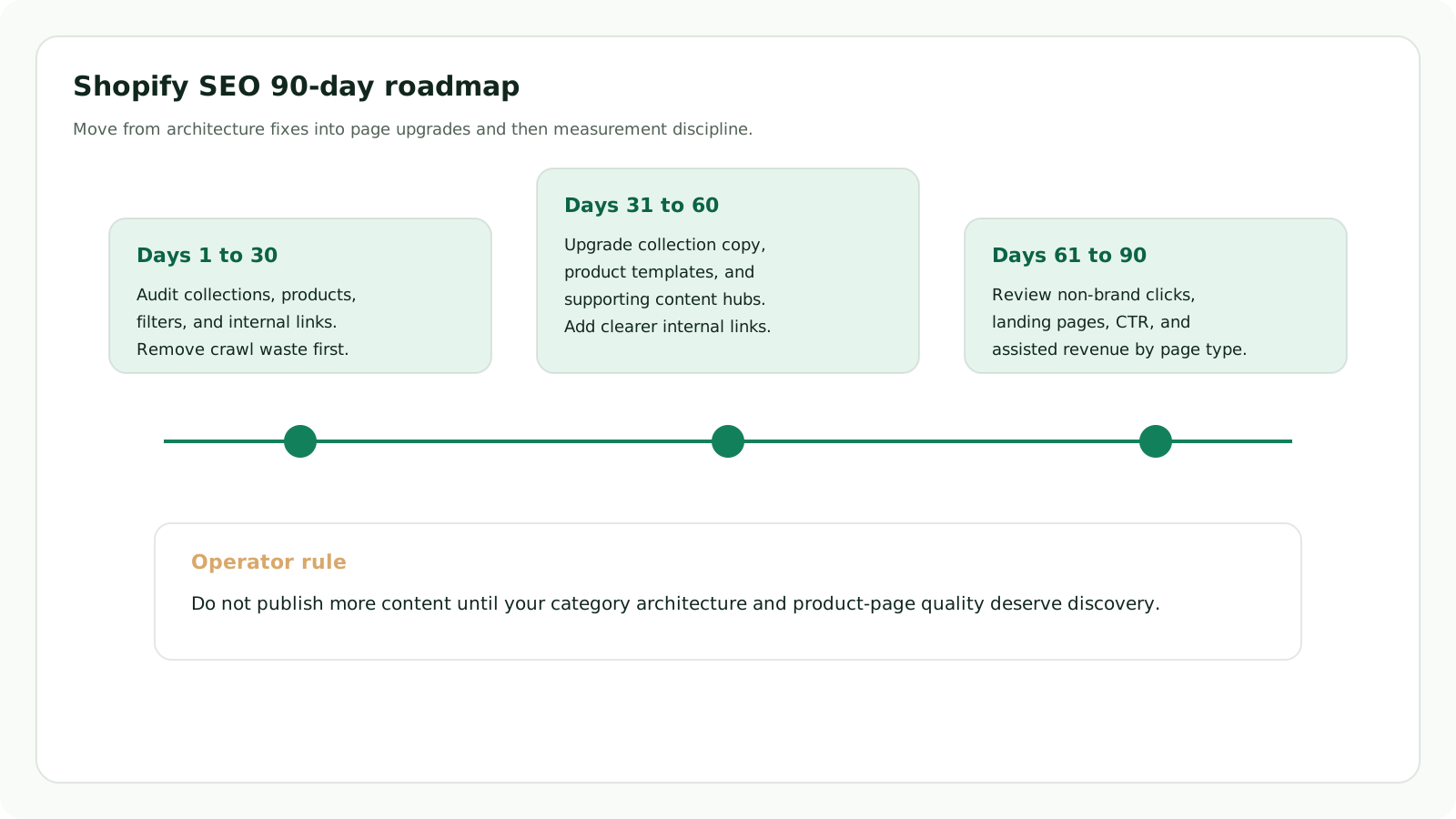
Sequence SEO work from architecture fixes into content upgrades and measurement instead of publishing randomly.
Days 1 to 30, architecture and hygiene
- audit collection overlap and keyword cannibalization
- review product-page depth for the most commercially important SKUs
- map crawlable navigation paths from home to category to product
- review filters, duplicate paths, empty states, and variant URL consistency
- fix broken internal-link patterns and weak anchor text
Days 31 to 60, commercial-page reinforcement
- rewrite top collections around real search intent
- upgrade priority product templates with stronger copy and FAQs
- add or validate product structured data
- improve titles and meta descriptions on pages already earning impressions
- build internal links from existing editorial content into priority pages
Days 61 to 90, supporting content and authority assets
- publish 1 to 2 buying guides tied to core collections
- publish 1 comparison or niche playbook page that supports real buying decisions
- launch 1 benchmark, glossary, or reference asset that can attract links
- review Search Console and GA4 for uplift by page type
- refresh pages with impressions but weak CTR or conversion quality
After that, repeat. Good Shopify SEO is cumulative. The stores that win are usually not doing magic tricks. They are steadily strengthening category intent, product usefulness, search presentation, and internal-link clarity.
Sources and further reading
- Google Search Central, ecommerce site structure
- Google Search Central, link best practices
- Google Search Central, faceted navigation guidance
- Google Search Central, ecommerce URL structure and variants
- Google Search Central, merchant listing structured data
- Google Search Central, Search Console plus Analytics for SEO
- Google Search Console, Performance report
- Shopify Help Center, SEO overview
- Shopify Help Center, site structure for search engines
- Shopify Help Center, titles and meta descriptions
- Shopify Help Center, improving online store performance
Frequently asked questions
Should Shopify merchants prioritize blogs or commercial pages first?
Commercial pages first. Collections and product pages should be strong enough to deserve rankings, then editorial content should support them by answering adjacent research questions and feeding internal-link relevance into those revenue pages.
Does Shopify already handle technical SEO for me?
Shopify handles some useful defaults such as canonical tags, sitemap.xml, robots.txt, SSL, and editable SEO fields. That helps, but it does not solve weak collection design, thin product copy, poor internal linking, or uncontrolled filter URLs.
Can niche pages help with SEO if the catalog is broad?
Yes, if they are real operational playbooks for specific merchant verticals. They should reflect merchandising, shipping, seasonality, product education, and app-stack differences, not thin keyword swaps.
Should every product variant have its own URL?
If variants matter meaningfully to search intent, then separate variant URLs can help Google understand them. The important part is consistency. Do not create a messy explosion of near-duplicate pages without a clear purpose.
How should I judge whether SEO is working?
Look beyond total sessions. Measure non-brand clicks, landing-page groups, query growth, CTR, assisted revenue, and whether important collections and products are actually gaining impressions and clicks.
Recommended reading
Keep exploring the playbook

Shopify AEO guide
A practical Shopify guide to answer engine optimization covering AI search visibility, product citability, structured data, Shopify Catalog, entity signals, and measurement.

Shopify collections strategy guide
A practical guide to structuring Shopify collections for search visibility, merchandising clarity, filtering, and stronger shopper paths.
Shopify product schema guide
A practical Shopify product schema guide covering Product, Offer, ProductGroup, variants, shipping, returns, Merchant Center, duplicate JSON-LD, and validation.
Need a technical second opinion?
Bring us the constraint, broken workflow, or inherited setup. The first 20-minute fit call is free.
Book a free fit call